DRAFT landing content. Not live.
Every sample, notice and report your water system owes in 2027, in one calendar.
If you run your own well for a mobile home park, a campground, a restaurant or a small school, Tap Check builds your year of sampling and paperwork, keeps your lab results and notices in one place, checks the results you enter against the limits and drafts the notices for you to check, sign and send.
iPhone, iPad and Mac apps are coming to the App Store.
Who it is for
Owners and managers of small private public water systems in Pennsylvania. Several federal duties land on the same systems in 2027: the new-format Consumer Confidence Report, PFAS initial monitoring and the lead service line work.
How it works
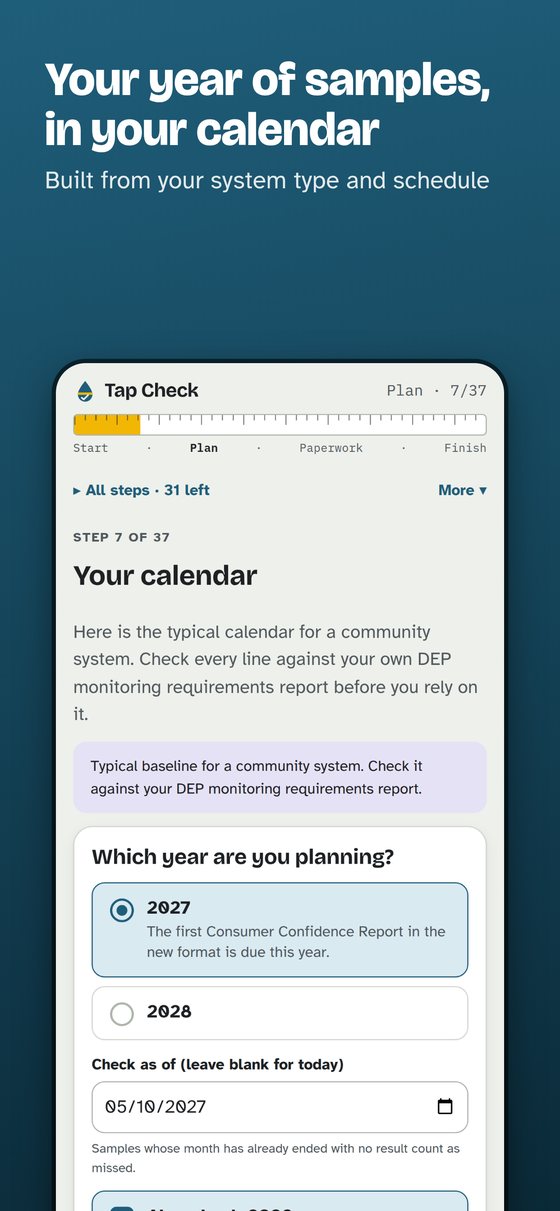
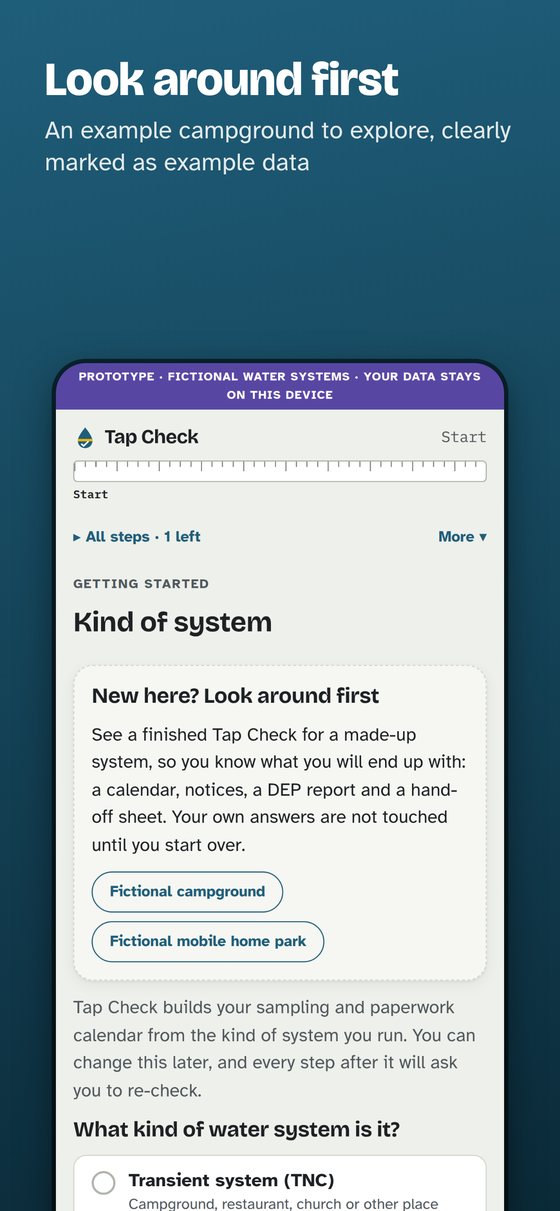
System type, population served, source, and your own DEP schedule. It builds your plan year. Not sure yet? Look around first with a fictional campground.
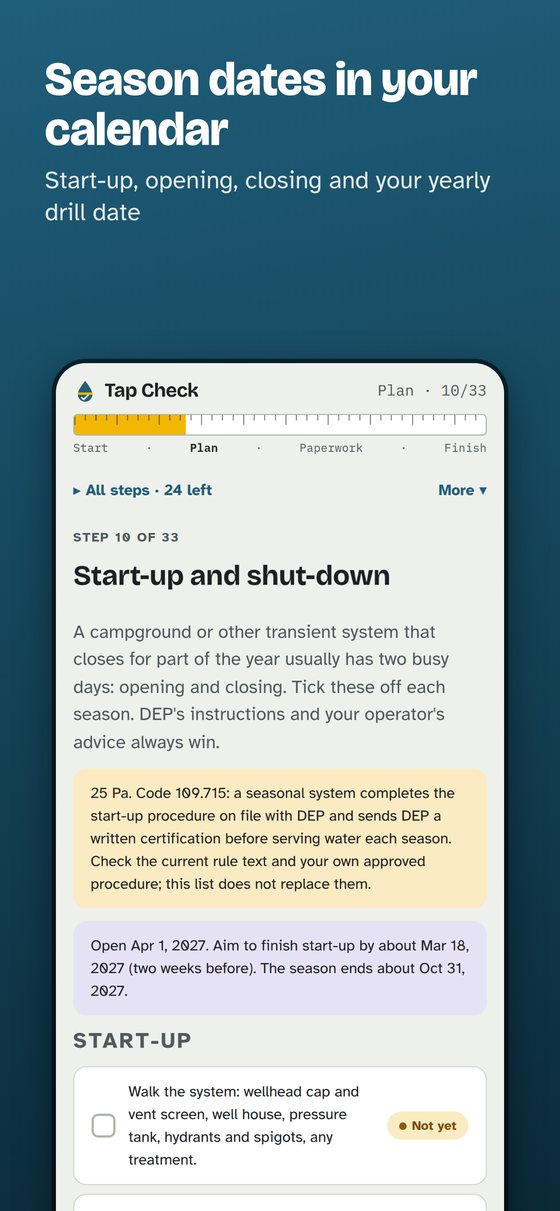
Every sample, fee, report, season start-up and closing, drill and backflow test date goes into your calendar with reminders.
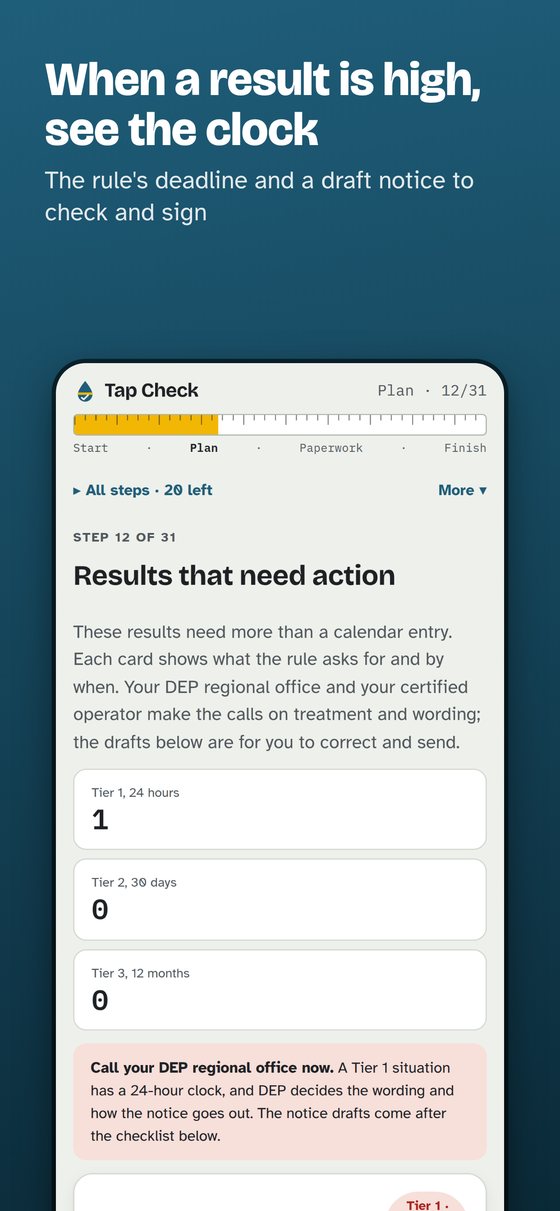
Results are checked against the limits. If one is high, the app shows the rule's clock and a draft notice.
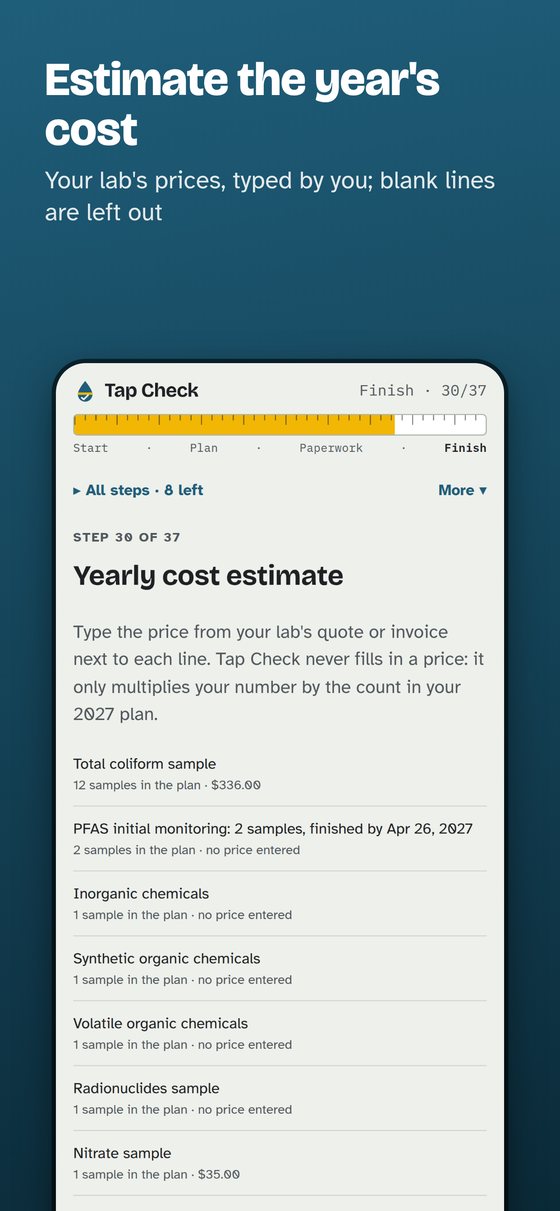
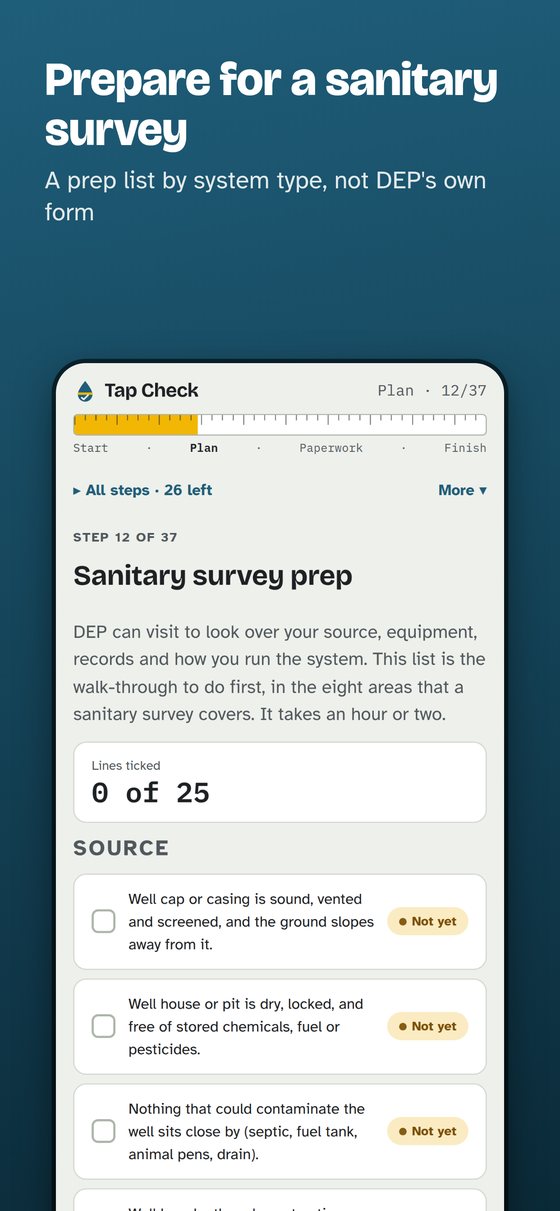
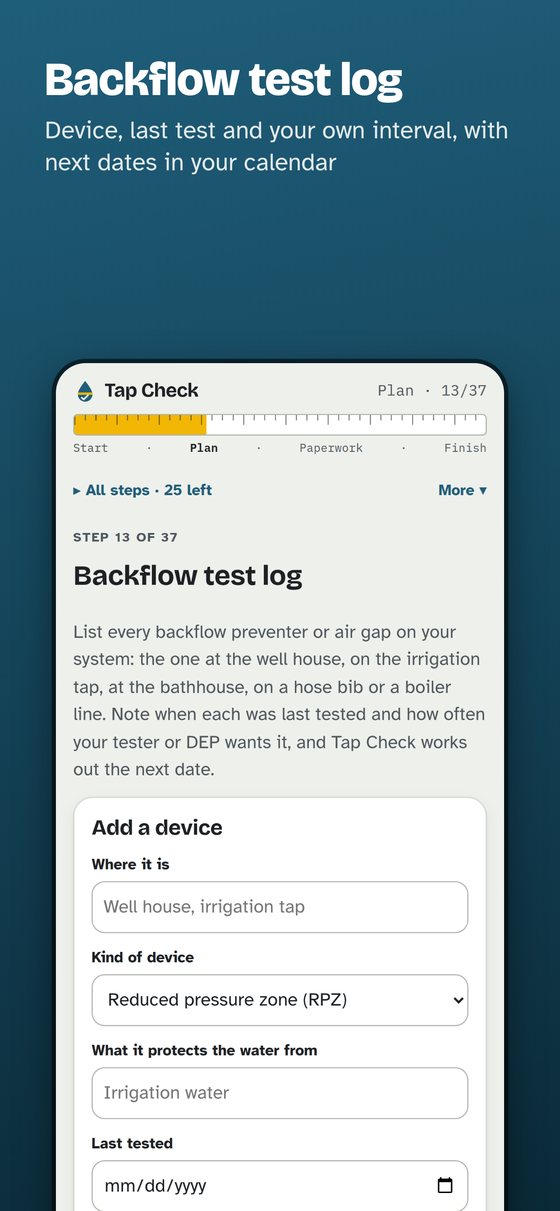
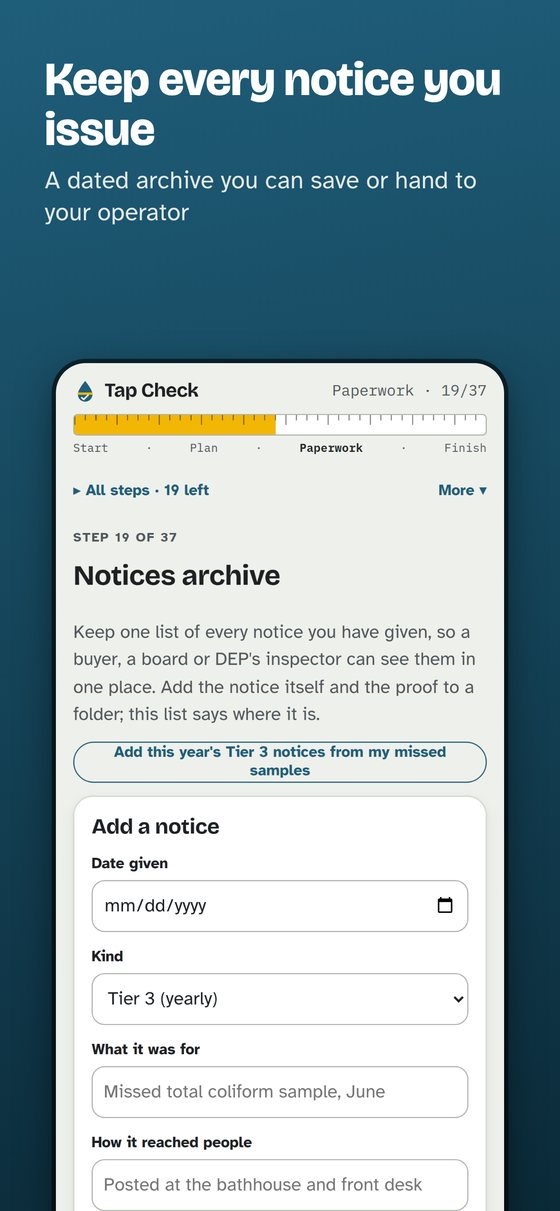
A yearly cost estimate from your lab's prices, a notices archive, a backflow test log, a sanitary-survey prep list and a training sign-off sheet.
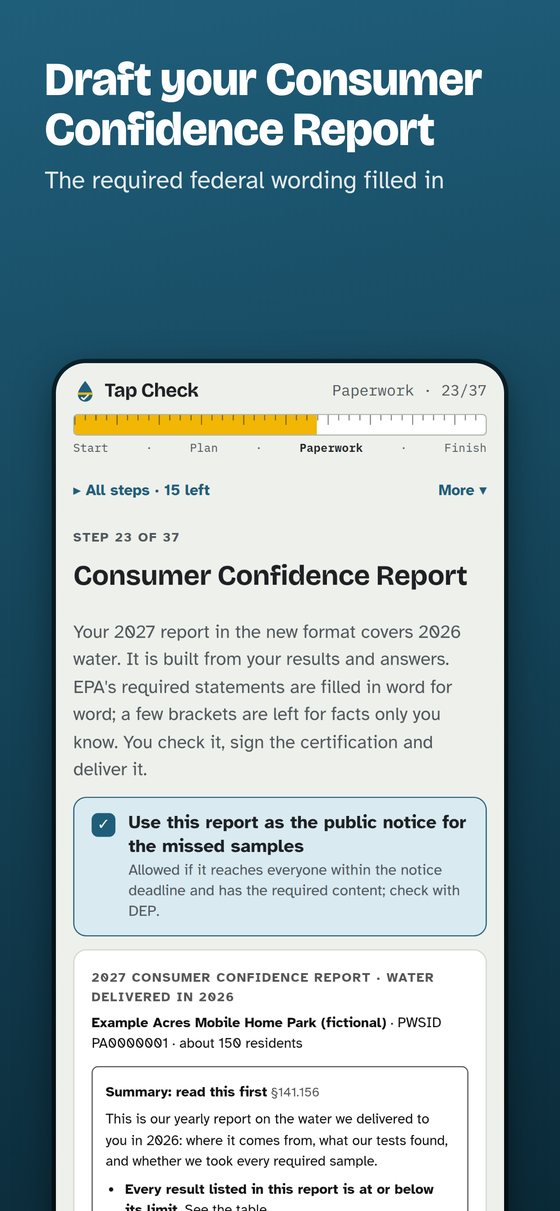
Notices, the service line inventory and the Consumer Confidence Report, ready for you to check, sign and send.
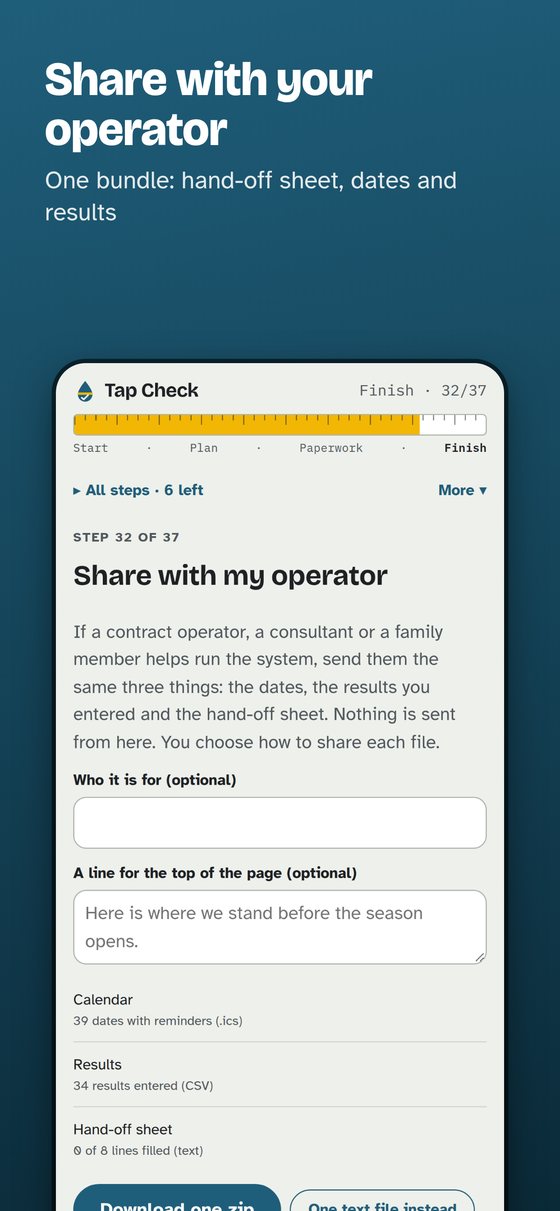
One bundle with the hand-off sheet, your next dates and your results, to send yourself.
What is in it
- The sampling calendar
- The missed-sample check
- Notice drafts and the DEP certification wording
- Service line inventory
- New-format Consumer Confidence Report
- Printable report
- Season start-up, opening, closing and drill dates in your calendar
- Yearly cost estimate: you type the lab prices, blank lines are left out
- Notices archive
- Backflow test log with your own interval
- Sanitary survey prep list, not DEP's form
- Staff training sign-off sheet
- Share-with-your-operator bundle (zip or text)
- A first-run example you can explore
- Several water systems on one phone
- A printable pump-house wall chart with this month's dates and your own daily and weekly rounds
- A rule change log with a source for each rule
- Your first notice: a walkthrough for a first missed-sample notice, with a printable cover sheet
- VoiceOver support
- Which group am I? Three questions suggest a kind of system; you choose, and your DEP letters decide
- A PFAS quick card with the first-round sampling dates from 40 CFR 141.902, marked check with DEP
- A disinfection residual log of your own readings, flagged only against the limits you type, with a printable monthly grid
- An opening-day checklist the month before a seasonal system opens
- One export: the same zip as Save everything, with a preview before you restore it
- A reminder note when your dates change after you added them to your calendar
2027 dates in the app
| Apr 26, 2027 | Federal PFAS initial monitoring window ends |
| Jul 1, 2027 | Consumer Confidence Report due to your customers (2026 data) |
| About Jul 11, 2027 | Copy and certification to DEP, if Pennsylvania's revised rule takes effect as drafted |
| Nov 1, 2027 | Lead and copper improvements rule compliance date |
Dates are the app's defaults. Check every one against your own DEP monitoring requirements report.
Price
| Campground or other transient system | $49 / year |
| Mobile home park or community system | $99 / year |
Planned yearly prices per water system: $49 a year for campgrounds and other transient systems, $99 a year for parks and community systems. The calendar and missed-sample check stay free. Not live yet: billing will go through the App Store when the app is released.
Known limitations
- The dates are defaults. Check every one against your own DEP monitoring requirements report.
- No real DEP report has been used to build the lab-report reader. DEP's report layout is not public, so the reader is tuned on typical lines. Check each line it finds.
- Pennsylvania's rule for the Consumer Confidence Report is still moving. The federal due date is July 1. The July 11 date for the copy and certification to DEP is an inference if the state rule takes effect as drafted, and is labelled so.
- PFAS and lead-and-copper dates follow the federal rules as published and as read on EPA's page and Cornell's copy of the rule, not the Federal Register. EPA's PFAS reconsideration could change them.
- Season start-up wording points to 25 Pa. Code 109.715; which form or sample your regional office wants is a question for the regional office. The survey and training lists are general good practice lists, and the backflow interval is whatever you type, because the rule has no interval.
- The cost lines are estimates from baseline sampling rounds. Transient systems are treated as outside the lead service line inventory step, on DEP's wording; confirm with DEP.
- English only for now. The one-zip operator share has been tested in browsers and a test harness, not yet on a phone's share sheet.
Private by design
- No account, no ads, no tracking. Your lab results stay on your device.
- The optional EPA record look-up sends only your water system ID.
- Tap Check does not send anything to DEP. You sign and send your own notices and reports.
- Works offline.
Questions
Does Tap Check tell me my system is in compliance?
No. It organises dates and checks the numbers you enter against the limits. It cannot know what your lab missed or what DEP has on file.
Is it a laboratory or a certified operator?
No. Samples are taken by you and analysed by an accredited laboratory. Tap Check is not a laboratory, not DEP and not legal advice.
Does it send my results to DEP?
No. Your accredited lab reports results to DEP. Tap Check never submits anything.
Are the dates exactly mine?
They are defaults from your system type. Always check them against your own DEP monitoring requirements report.
What does it cost?
Planned: $49 a year for campgrounds and other transient systems, $99 a year for parks and community systems. The calendar and missed-sample check are free.
Does it need the internet?
No. It works offline. The optional EPA look-up needs a connection and sends only your water system ID.
Where does my information go?
Nowhere. Everything stays on your device.
Does my mobile home park need a Consumer Confidence Report?
DEP treats a park with its own water supply as a community system, and community systems deliver one by July 1.
Who has to get the report?
Your customers, including residents who use the water. Tap Check drafts it and keeps a delivery log.
Do I keep a copy?
Yes, three years. Tap Check keeps your delivery proof with the report.
Self-help organiser for your own water system. Not a laboratory, not DEP and not legal advice. You take the samples, check every date against your DEP monitoring schedule, and sign and send your own notices and reports.
More to read
- Tap Check, a paper binder, or a consultant? How small water systems keep the year straight
- Questions owners ask
- Accessibility statement
Tap Check is made by Barnyard Greens. Support: support@barnyardgreens.farm (not live yet).